
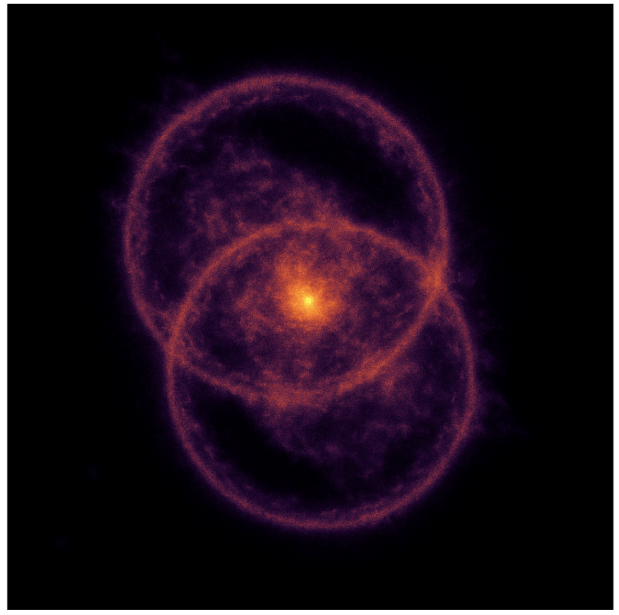
Astrophysicists, including researchers from the National Center for Nuclear Research, have observed and described the most distant and largest “unusual radio circle” to date (Odd Radio Circle, ORC). It is a huge, ring-shaped cloud of radio radiation composed of charged plasma, whose image dates back about 7 billion years – to a time when the Universe was half its current age. The discovery was published in the prestigious journal Monthly Notices of the Royal Astronomical Society.
ORCs are a relatively new class of cosmic structures, first observed only six years ago. They are very large and faint rings of radio emission that can be up to twenty times larger than the Milky Way. Their nature and formation mechanisms are still the subject of intense research. Scientists speculate that they may be related, among other things, to shock waves generated by collisions of supermassive black holes or powerful winds generated by active galaxies.
The newly discovered object, designated RAD J131346.9+500320, was observed at a redshift of ~0.94, which means that the light that reached us was emitted 7 billion years ago. Its diameter exceeds one million light-years, making it the largest ORC known to date. A special feature of this object is the presence of two intersecting rings – only the second such observation in the history of space research.
The discovery was made possible thanks to the collaboration of professional astronomers with participants in the RAD@home Astronomy Collaboratory project, a citizen science initiative in which astronomy enthusiasts from around the world support the analysis of scientific data. The key observations were made using the LOFAR telescope, the most sensitive instrument for low-frequency radio wave research. The results show that ORCs may be part of a larger group of exotic plasma structures formed as a result of complex interactions between black holes, galactic winds, and their surroundings.
The research is also of great importance to the Polish scientific community. NCBJ is a member of the Polish SKA Consortium, which is preparing Polish researchers to participate in the Square Kilometre Array Observatory project – currently the largest radio telescope in the world. Involvement in international projects and cooperation with civic research projects underscore Poland’s growing role in global astrophysical research.
The same analyses also discovered two extremely large radio galaxies. One of them, RAD J122622.6+640622, has a diameter of nearly three million light-years, and its stream of matter forms a spectacular ring with a diameter of one hundred thousand light-years. The second, RAD J142004. 0+621715, reaches a size of nearly one and a half million light-years and has a similar ring at the end of one of its jets. Their unusual shapes suggest that the formation of these structures may be related to the interaction of charged plasma moving at a speed close to the speed of light.
Future observatories, such as SKAO, combined with large sky surveys, will enable even more accurate study of ORCs and similar structures. However, the discovery of the largest and most distant ORC is already an important step towards a better understanding of the role of black holes and the environment of galaxies in the evolution of the cosmos.