
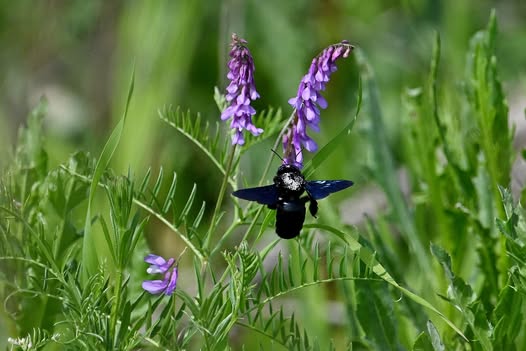
The presence of the black bee, a species of carpenter bee (Xylocopa), has been documented for the first time in Roztocze National Park. This rare and protected insect was considered to have been extinct in Poland for years.
The discovery was made on May 31, 2025, in Florianka, a forest settlement surrounded by flower-filled meadows. The violet carpenter bee (Xylocopa violacea) and the black carpenter bee (Xylocopa valga) are strictly protected species and are listed in the Polish Red Book of Animals.
These bees are important pollinators of plants such as field beans, vetch, and viper’s bugloss. They nest in dead wood, where they gnaw out tunnels and lay their eggs. Despite their impressive size, these insects are gentle—they only become aggressive when defending their nests.
The presence of the carpenter bee in Roztocze National Park is part of a broader trend of this species returning to Poland. In recent years, it has been observed in Białowieża, the Bieszczady Mountains, Ojców National Park, Polesie, and in 2024 on the campus of the University of Wrocław. According to experts, its reappearance in our country is linked to both climate warming and environmental improvements, particularly the increased availability of dead wood.
This discovery is of great significance for biology and biodiversity conservation, and it also highlights the role of national parks as sanctuaries for endangered species.
Source: Science in Poland