
Physicists from the University of Warsaw and Emory University in Atlanta (USA) have shown that interactions between atoms can enhance superradiance—a quantum effect involving a collective, amplified burst of light. This discovery brings new knowledge to research on light-matter systems and opens up prospects for the development of modern quantum technologies. The results were published in the prestigious journal Physical Review Letters.
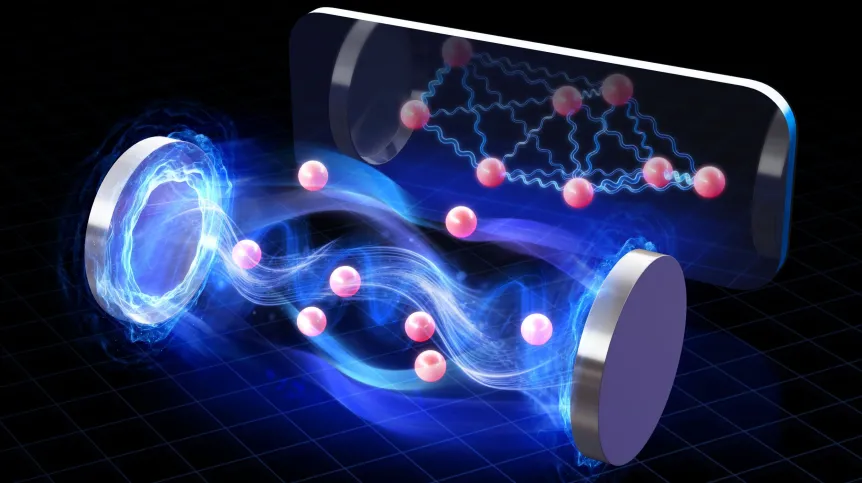
A team of researchers from the Faculty of Physics at the University of Warsaw, the Center for New Technologies at the University of Warsaw, and Emory University analyzed how the mutual interactions of atoms affect the way these atoms interact with light in optical cavities. In such systems, many emitters—e.g., atoms—are in the same optical mode, which enables collective coupling and the emergence of effects that are absent in the case of single particles. One of these is superradiance—a situation in which many atoms radiate in phase, jointly amplifying the light pulse. Until now, theoretical models have focused mainly on light-matter coupling, ignoring the short-range dipole-dipole interaction between neighboring atoms. However, as recent calculations show, such interactions can not only compete with photon-mediated effects, but also amplify them.
The scientists have developed a new computational approach that preserves quantum correlations between light and matter. Thanks to this, they have shown that interactions between nearby emitters can lower the threshold for superradiance and also lead to the formation of new, previously unknown states of matter with superradiant properties. This is an important step towards more precise modeling of phenomena occurring in quantum systems.
The results obtained have potential practical applications. Controlled atomic systems are the basis for developing quantum technologies – from quantum batteries to communication networks and sensitive sensors. By regulating the interactions between emitters, it will be possible in the future to influence the charging dynamics of such devices and design more efficient systems based on collective effects.