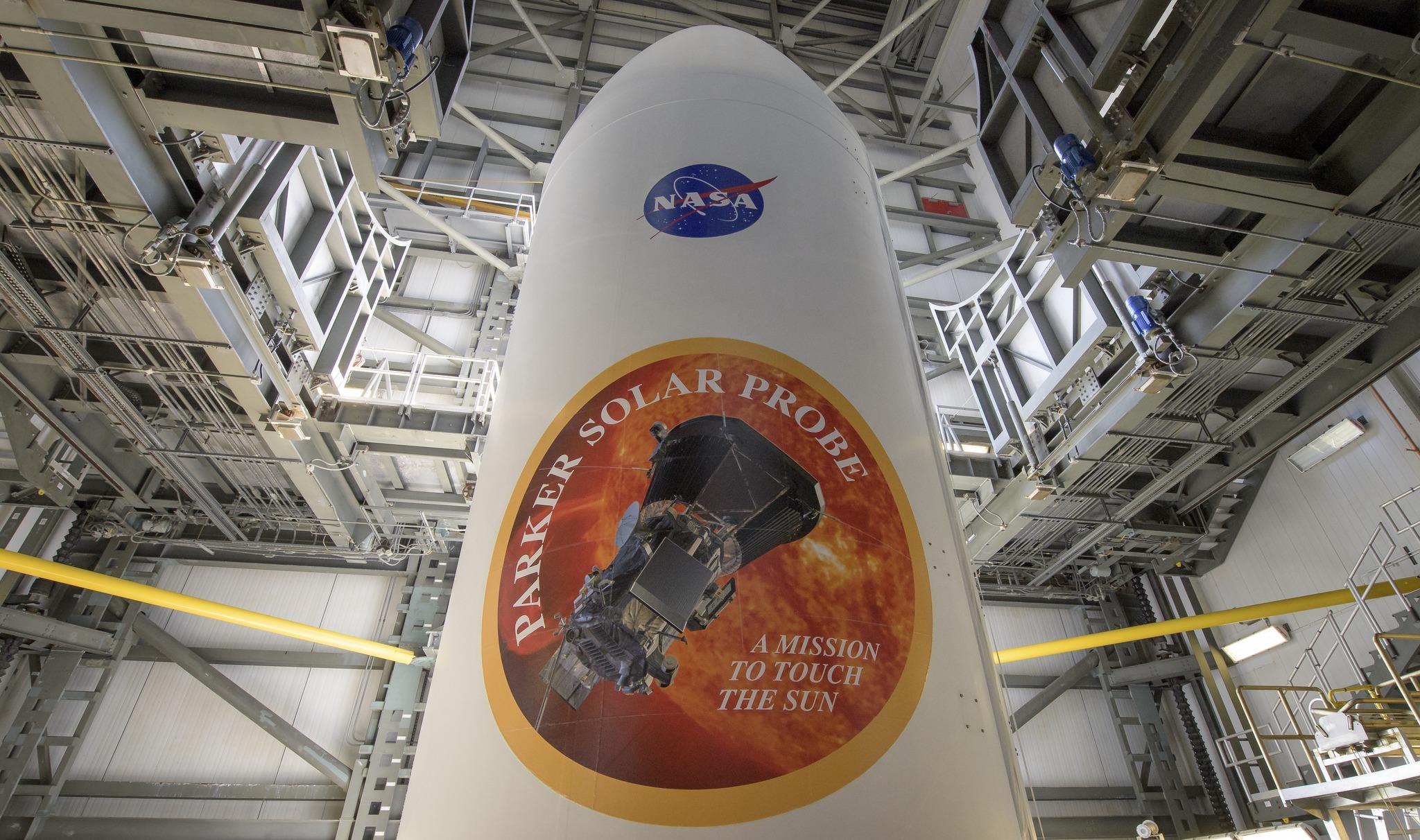
Just 6.1 million kilometers (3.8 million miles) from the Sun’s surface—that’s an astonishingly close distance reached by NASA’s Parker Solar Probe in December of last year, when it captured the closest images of our star ever taken.
This breakthrough scientific achievement not only delivered spectacular images, but also helped researchers better understand two of the most important and intriguing astrophysical phenomena: the origins of the solar wind and the mechanisms that heat the Sun’s corona to temperatures far higher than those on the Sun’s surface.
The Parker Solar Probe mission began in August 2018. The spacecraft, about the size of a small car and weighing over 600 kg, was engineered to operate in extreme conditions—able to withstand temperatures up to 1400°C, while its instruments remain protected at near room temperature. During its record-setting flyby on December 24, 2024, the probe was traveling at the amazing speed of about 690,000 kilometers per hour, and its thermal shield had to endure nearly 1000°C.
Thanks to the Wide-Field Imager for Solar Probe (WISPR), the mission captured extremely valuable data showing the solar wind—a stream of charged particles continuously flowing from the Sun’s corona, traveling through the Solar System and affecting satellites and astronaut operations. The probe also recorded coronal mass ejections (CMEs)—violent explosions of plasma and magnetic fields whose impacts can threaten technology both in orbit and on Earth.
Scientists observed for the first time the merging of CMEs, which complicates prediction of their paths and potential effects. These collisions may accelerate particles and influence the structure of magnetic fields, making CMEs more unpredictable and hazardous.
The Parker Solar Probe confirmed the existence of two types of slow solar wind—the so-called Alfvénic wind, marked by subtle twists in the magnetic field, and non-Alfvénic wind, which lacks such changes. The data suggest these two wind types may have completely different origins: one stemming from coronal holes, the other from loop structures connecting active areas on the Sun’s surface.
The probe is named after Eugene Parker, the American astrophysicist who, back in 1958, proposed the then-controversial hypothesis of a solar wind—a theory that today forms the bedrock of our understanding of the heliosphere. Thanks to his vision and scientific boldness, humanity has gained the ability to study the most inaccessible regions of the Solar System.
Sources: NASA, dzienniknaukowy.pl