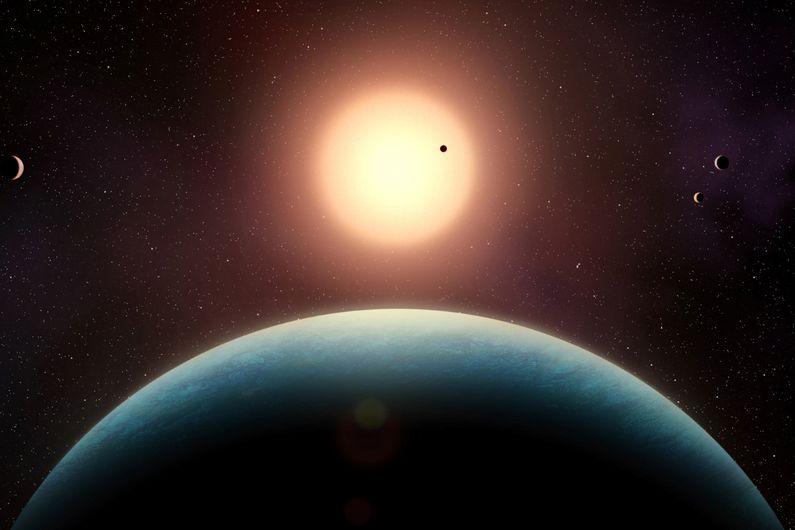
A team of researchers from the Trottier Institute for Research on Exoplanets (IREx) at the University of Montreal has confirmed the existence of a fifth planet in the L 98-59 system—a rocky world with a mass of about 2.8 Earth masses, located in the so-called habitable zone, where conditions could support liquid water. This remarkable discovery brings scientists closer to answering one of the most important questions in modern astrophysics: does life exist somewhere beyond Earth?
The L 98-59 planetary system, located approximately 35 light-years from Earth, has attracted significant attention from astronomers for several years. It consists of five planets orbiting a red dwarf star—a cool star with a mass smaller than the Sun. The first three planets were discovered in 2019 thanks to the TESS (Transiting Exoplanet Survey Satellite) space telescope, and a fourth was found in 2021 with the help of the Very Large Telescope (VLT) in Chile. At that time, initial evidence suggested the presence of a fifth planet, but it has only now been definitively confirmed.
By analyzing data collected from space telescopes (TESS, JWST) and HARPS and ESPRESSO spectrographs at ground-based observatories, the team led by Charles Cadieux applied innovative data processing methods that allowed them to separate planetary signals from disturbances caused by the star’s activity. This made it possible to precisely estimate the masses and orbits of all five known planets in the system.
The fifth planet, the newest addition to the L 98-59 system, resides in the habitable zone—an area where temperatures could allow for the existence of liquid water. It receives roughly the same amount of energy from its star as Earth does from the Sun and orbits it every 23 days. Moreover, it moves in an almost circular orbit, which further increases the chances of climate stability and potential conditions suitable for life.
The research results were published in The Astronomical Journal