
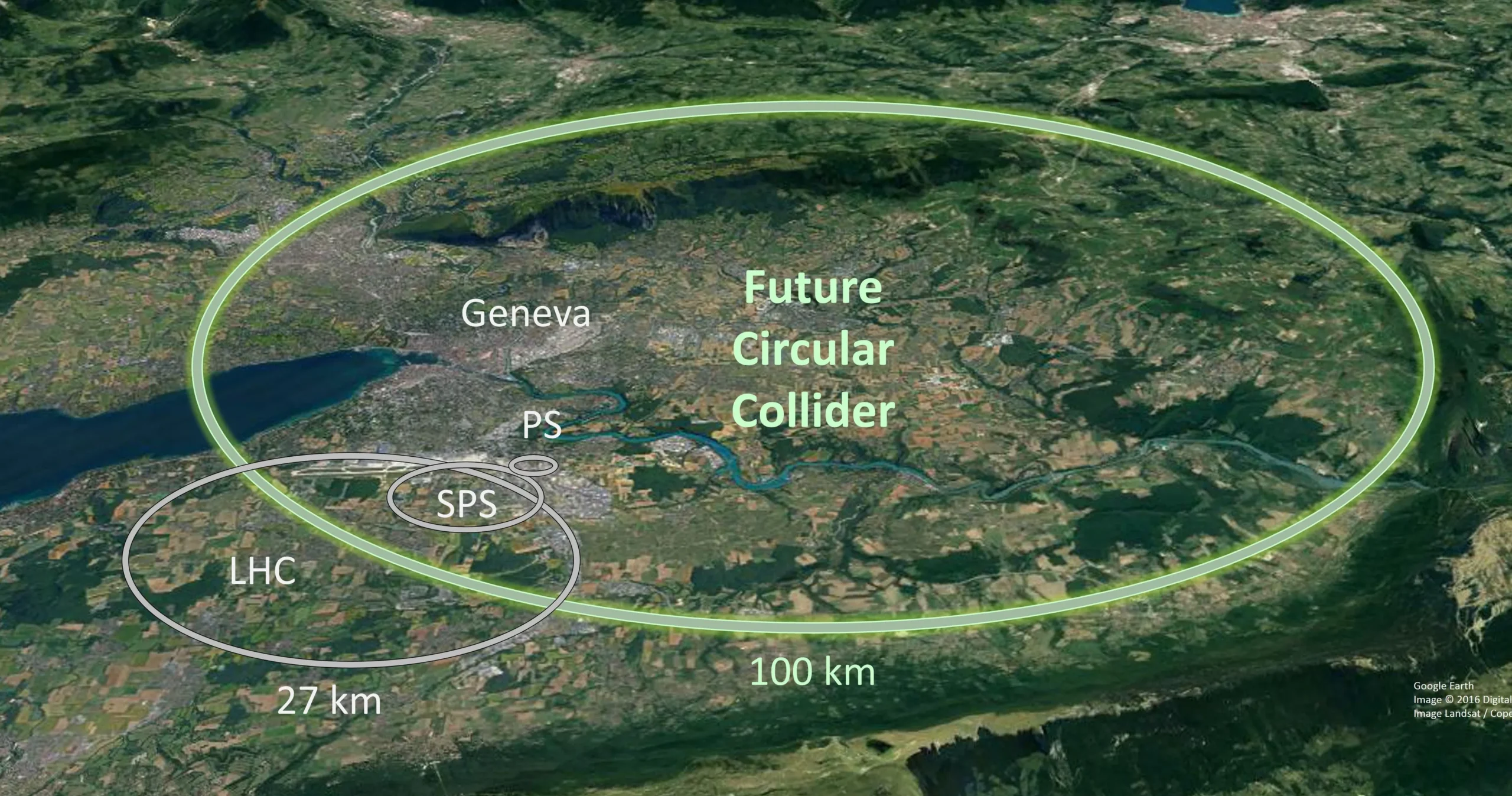
On March 31, 2025, the European Organization for Nuclear Research (CERN) presented its Future Circular Collider (FCC) Feasibility Report. This ambitious undertaking involves the construction of a new particle gas pedal with a circumference of 90.7 kilometers, more than three times the length of the current Large Hadron Collider (LHC). The project aims to explore fundamental aspects of particle physics and search for phenomena beyond the current Standard Model.
 Schematic map showing the possible location of the Future Circular Collider (FCC) (Photo: CERN)
Stages of the project
The FCC is to be implemented in two main stages. The first, FCC-ee, envisions colliding electrons with positrons, which will enable precise studies of the Higgs boson and other particles. The second stage, FCC-hh, involves colliding protons at energies as high as 100 TeV, which will allow exploration of new areas of high-energy physics. The FCC-ee is scheduled to begin operation in the mid-2040s, while the FCC-hh would start in the 2070s.
The estimated cost of building the FCC is about 15 billion Swiss francs ($17 billion). CERN says it will cover 65% of this amount from its own budget, but no detailed financing plan is yet available. The project is expected to be decided by CERN member states in 2028.
Alternative projects around the world
In addition to the FCC, other particle gas pedal projects are being considered around the world. In Japan, an International Linear Collider (ILC) of about 20 km is being planned that would collide electrons with positrons. However, the project faces difficulties due to a lack of political support and uncertain funding.
China, on the other hand, is planning to build a Circular Electron Positron Collider (CEPC) with a circumference of 100 km. The project, estimated to cost around $5 billion, is expected to begin construction in 2027 and be completed by 2035. The CEPC aims to precisely study the Higgs boson and prepare the ground for a future proton-proton collider with even higher energies.
Social significance
Although the construction of such devices involves enormous costs, their impact on the development of technology and science cannot be overestimated. Examples include the creation of the World Wide Web at CERN or the development of medical technologies such as positron emission tomography. In addition, research conducted at such centers contributes to a better understanding of the fundamental laws governing the universe, which could lead to major scientific breakthroughs in the future.
Sources: home.web.cern.ch, home.cern, globaltimes.cn, Latest news & breaking headlines, The Guardian / Photo: CERN, VOX.com