
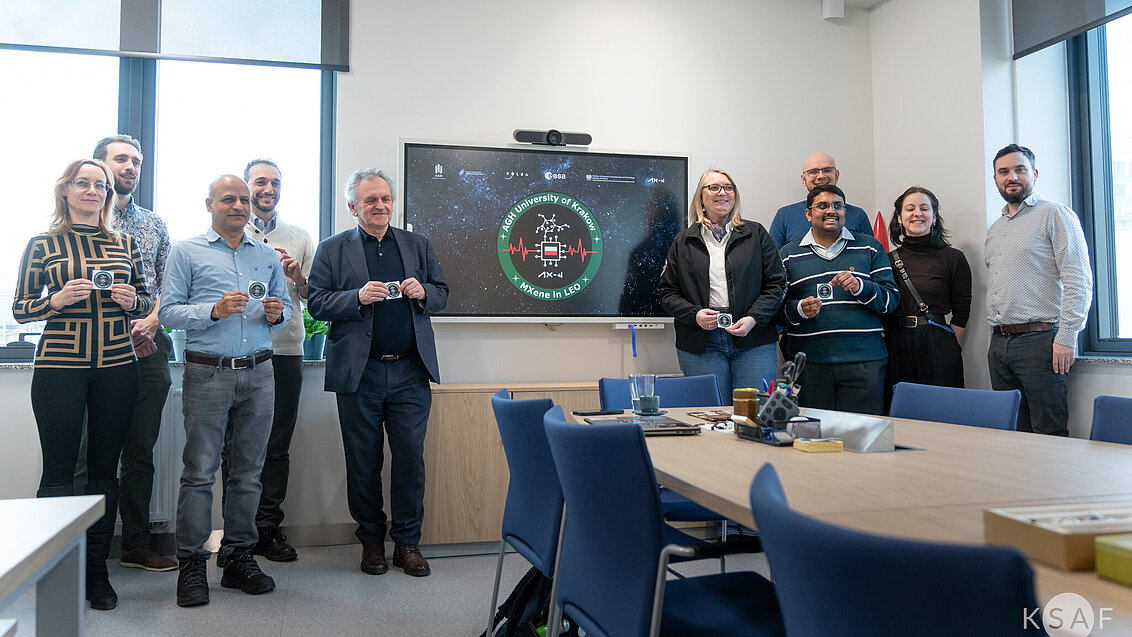
Scientists from the AGH University of Science and Technology in Kraków are conducting the “MXene in LEO” experiment as part of the Polish IGNIS space mission. The aim is to test the performance of sensors based on MXene nanomaterials in low Earth orbit (LEO) conditions. The launch of Ax-4 mission, involving Polish astronaut Dr. Sławosz Uznański-Wiśniewski from the European Space Agency (ESA) project, is scheduled for May 29, 2025. The mission will last two weeks.

MXene – a modern material for space technology
MXenes are two-dimensional nanomaterials discovered in 2011, consisting of carbides, nitrides, and carbonitrides of transition metals. They are characterized by high electrical conductivity, mechanical flexibility, and the possibility of surface modification, which makes them attractive for applications in electronics and sensors. The experiment used MXenes based on titanium carbide (Ti₃C₂), which the AGH team synthesizes themselves.
The experiment consists of two parts. The first involves automatically testing the stability of MXene sensors placed on a PCB board in a special 13 × 9 × 6 cm enclosure. Once launched, the system will operate autonomously throughout the mission, recording data on the behavior of the material in microgravity conditions.
Wristbands with pulse sensors made of bacterial cellulose
The second part of the experiment involves testing wristbands made of bacterial cellulose, on which MXene-based pulse sensors are printed. Bacterial cellulose is a biocompatible material that can be used as an alternative to petrochemical-based plastics. The sensors use the piezoresistive effect—changes in the electrical resistance of the material under mechanical stress—to monitor the user’s heart rate.

The role of the astronaut in the experiment
Dr. Sławosz Uznański-Wiśniewski will test the wristbands by performing specific wrist movements, such as bending and rotating. The aim is to assess the accuracy of pulse measurements in dynamic conditions. Twelve tests are planned with six wristbands, each of which will be used twice.
One of the advantages of MXens is that they can be printed using 3D printing technology, which is important in the context of long-term space missions. Both the sensors and the bacterial cellulose bands can potentially be manufactured and repaired directly on board the International Space Station, which increases the autonomy of astronauts and reduces mission costs.
The “MXene in LEO” experiment is coordinated by Dr. Shreyas Srivatsa. The team from the AGH University of Science and Technology’s Faculty of Space Technology also includes Prof. dr hab. Tadeusz Uhl, Eng., Dr. Agata Kołodziejczyk, Krzysztof Grabowski, PhD, Eng., Dagmara Stasiowska, PhD, Eng., Dr. Darukesha Baraduru Hirematada, Wojciech Guziewicz, MSc, Eng., and Sławomir Rudawski, MSc, Eng. The project is being carried out in cooperation with the European Space Agency (ESA), Axiom Space, and the Polish Space Agency (POLSA).
If the experiment is successful, MXene sensor bands may find application not only in space missions, but also in medicine and telemedicine on Earth. Flexible, biocompatible sensors can be used to monitor patients’ vital signs in real time, opening up new possibilities in diagnostics and healthcare.
Sources: AGH SpaceTech, Frontiers in Sensors, MDPI Micromachines, RSC Nanoscale, LinkedIn AGH SpaceTech / Photo: spacetech.agh.edu.pl