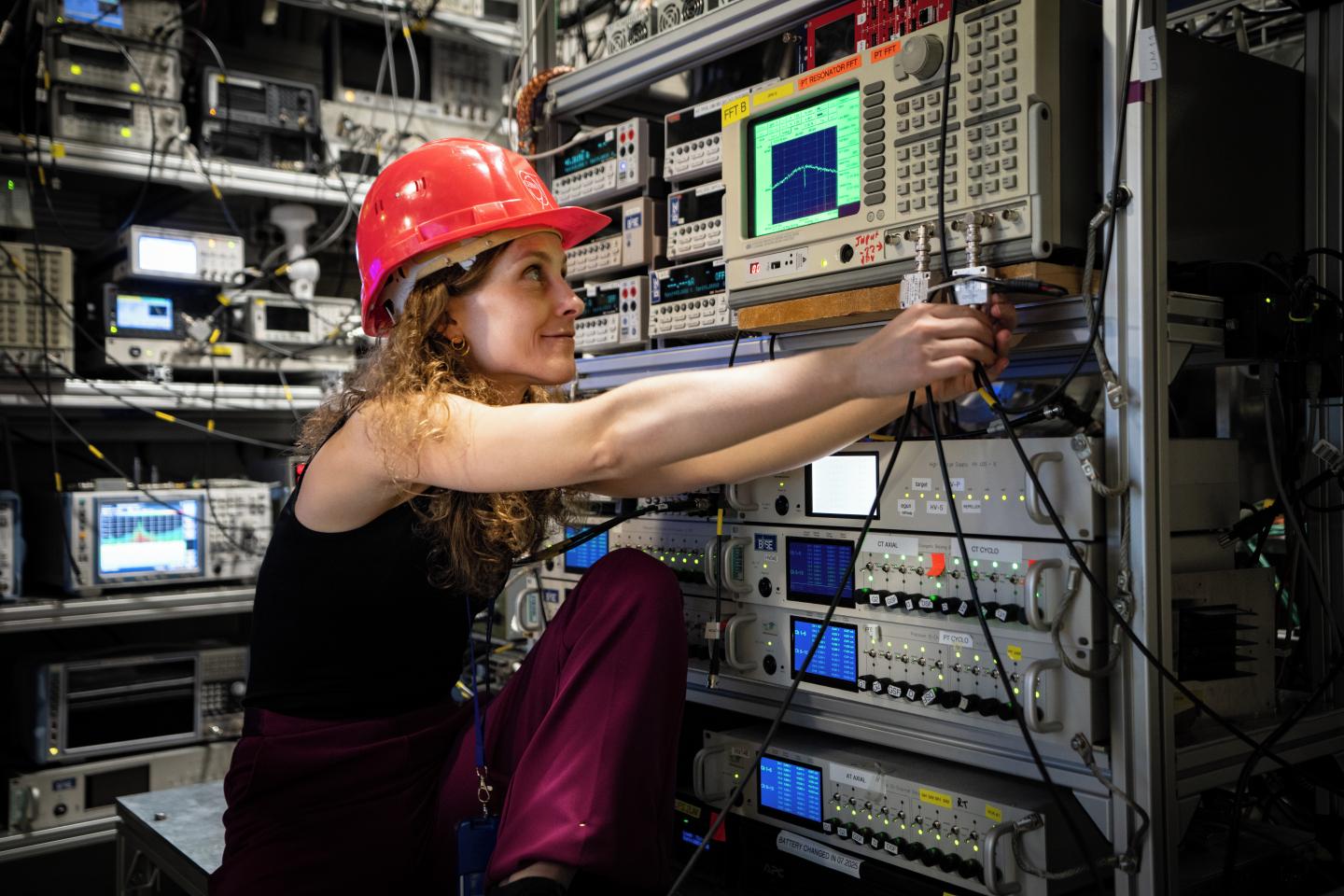
An international team of scientists working on the BASE experiment at the European Organization for Nuclear Research (CERN) has achieved a groundbreaking milestone in fundamental physics. Dr. Barbara Latacz played a key role in the study, presenting the world’s first quantum bit (qubit) built from antimatter. The results were published on July 23, 2025, in the journal Nature.
As part of the experiment, researchers succeeded for the first time in maintaining a single antiproton— the antiparticle of the proton— in a coherent quantum superposition state for a record time of 50 seconds. The antiproton has the same mass as the proton but carries the opposite electric charge. Its spin can exist in two quantum states, and controlling the transitions between these states provides the basis for qubits, the elementary units of information in quantum computing. Up to now, qubits have been constructed exclusively from matter particles.
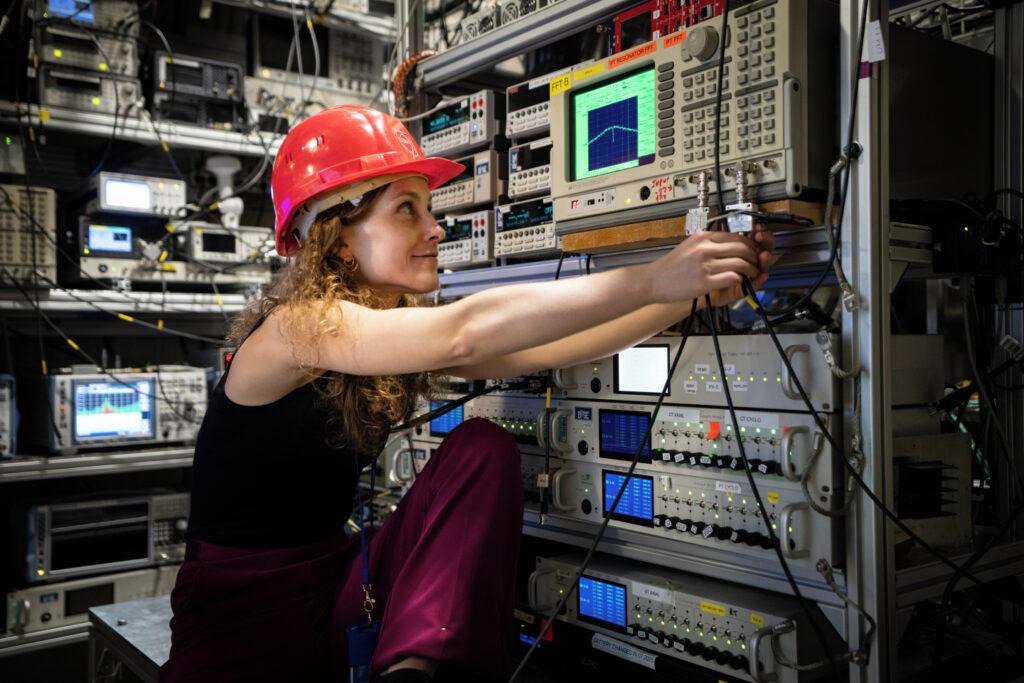
The BASE team employed advanced Penning traps and the technique of coherent spectroscopy of quantum transitions, which enables exceptionally precise measurements of the magnetic properties of particles. By stabilizing the magnetic field and reducing decoherence, the researchers achieved unprecedented stability of the quantum state of a single antiproton.
This achievement represents a significant step toward more precise tests of CPT symmetry (charge–parity–time), which states that matter and antimatter should display identical properties. Any deviation from this principle could point to phenomena beyond the Standard Model of particle physics.
The team’s next objective is to implement the BASE-STEP system, designed to transport antiprotons into environments with lower levels of magnetic interference. This could extend coherence times by up to a factor of ten, allowing for even greater measurement precision.
Dr. Barbara Latacz’s contribution is a testament to the important role Polish scientists play in some of the world’s most advanced research projects, and it serves as an inspiration for future generations of researchers.