

Scientists from the AEgIS experiment at CERN have made a breakthrough by using CMOS matrices from smartphone cameras to record antiproton annihilation with unprecedented precision. This makes it possible to study the effect of gravity on antimatter with a degree of accuracy that was previously unattainable.
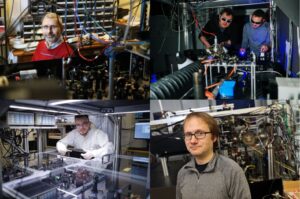
The international group of researchers from CERN includes scientists from the Institute of Physics and the FAMO National Laboratory at the Institute of Physics of the Nicolaus Copernicus University. Top left: Prof. Roman Ciuryło, Dr. Łukasz Kłosowski, Prof. UMK, Dr. Mariusz Piwiński, Prof. UMK, Adam Linek, M.Sc., and Dr. Michał Zawada, Prof. UMK. Source: UMK press materials
New application of consumer technology
The AEgIS team, which also includes Polish scientists from the Warsaw University of Technology, the Institute of Physics of the Polish Academy of Sciences, Nicolaus Copernicus University in Toruń, and Jagiellonian University, has developed a detector consisting of 60 modified CMOS matrices. The same matrices found in smartphone cameras, after appropriate modifications, enable the recording of antiproton annihilation in real time with a resolution of approximately 0.6 micrometers, which is a 35-fold improvement over previous methods.
A breakthrough in antimatter research
The AEgIS experiment aims to measure the effect of gravity on antihydrogen, the equivalent of hydrogen composed of an antiproton and a positron. To do this, scientists create a horizontal stream of antihydrogen and measure its vertical displacement using a moiré deflectometer and a detector that records annihilation points. Precise determination of these points is crucial to understanding whether antimatter behaves the same as matter under the influence of gravity.
Challenges and innovations
In order to adapt CMOS matrices for particle detection, it was necessary to remove surface layers, such as microlenses, which are standard in cameras. This exposed the light-sensitive part of the matrix, allowing the traces left by the particles to be recorded. Interestingly, analysis of the detector data showed that manual determination of annihilation points by humans was more accurate than automatic algorithms, highlighting the importance of human intuition in scientific data analysis.
Significance for the future
The use of consumer technology in advanced scientific research opens up new possibilities for particle physics. CMOS-based detectors are not only cheaper, but also more compact and precise than traditional silicon detectors. This approach could revolutionize the way high-energy physics experiments are conducted, making them more accessible and efficient.
Sources: naukawpolsce.pl, Science Advances, home.cern / Photo: UMK press materials