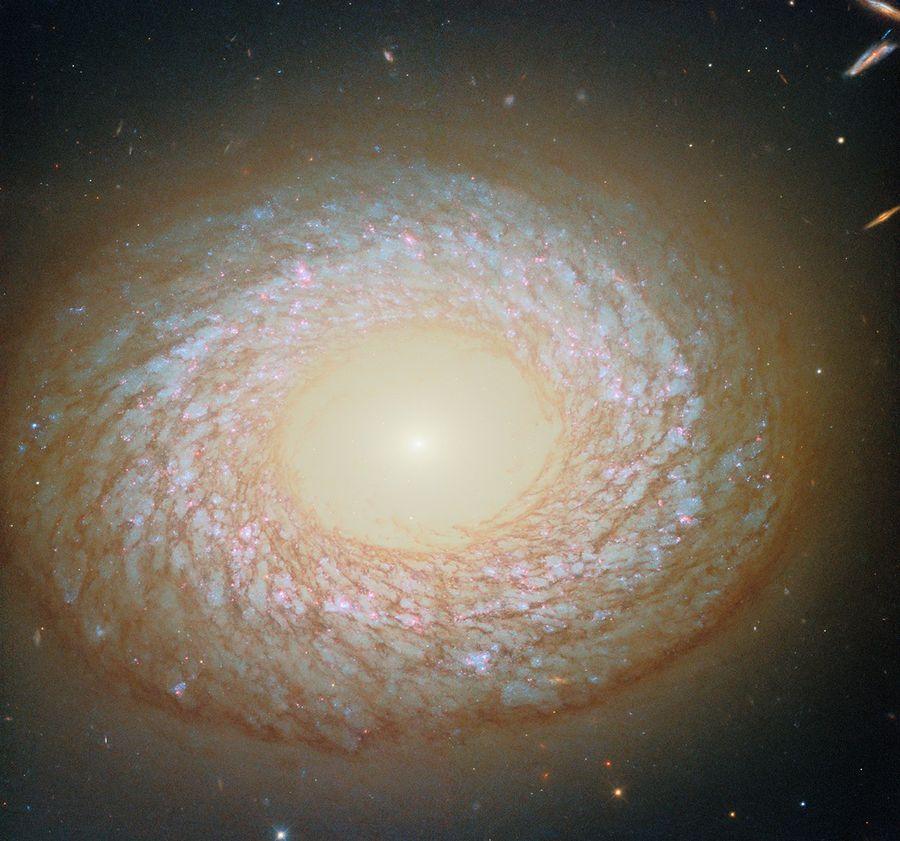
The latest observations made by the Hubble Space Telescope (NASA/ESA) show a galaxy that is difficult to classify unequivocally. NGC 2775, located about 67 million light-years from Earth in the constellation Cancer, combines the characteristics of different types of galaxies.
Its center is smooth and devoid of gas, resembling an elliptical galaxy. In contrast, the surrounding ring is full of dust and young star clusters, making it similar to a spiral galaxy. Astronomers have been debating for years whether NGC 2775 is a spiral, elliptical, or perhaps lenticular galaxy—one that has features of both types.
A tail of hydrogen gas stretching nearly 100,000 light-years has been discovered around NGC 2775 – a remnant of galaxies that may have been absorbed by it in the past. Such cosmic collisions may have contributed to its current unusual appearance.
Most researchers classify NGC 2775 as a so-called flocculent spiral galaxy – a spiral with faint, “feathery” arms. These discontinuous arms form clusters of young stars and gas clouds, giving the galaxy its distinctive appearance.
The previous image of this galaxy was published in 2020. The latest version has been enhanced with observations of red light emitted by hydrogen clouds surrounding massive young stars. As a result, the pink, glowing areas in the image indicate where new stars are being born.