
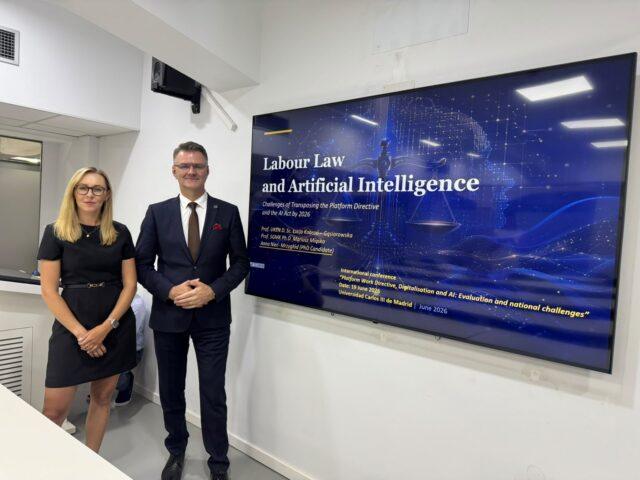
Dr Mariusz Miąsko from the Nicolaus Copernicus Superior School took part in the international conference “The Platform Work Directive, Digitalisation and AI: Assessment and National Challenges” at Universidad Carlos III de Madrid. Together with Anna Nieć-Mrzygłód, General Director of the Viggen Law Firm, and Prof. Łucja Kobroń-Gąsiorowska of the University of the National Education Commission in Kraków, he presented a paper titled “Employment Law and Artificial Intelligence: Challenges in Transposing the Platform Work Directive and the AI Act by 2026,” based on long-term research into changes in labour law driven by EU regulations on digital platforms and artificial intelligence.
New employer obligations under EU regulations
Over the coming months, three legal acts will come into force across the European Union, including Poland: Directive (EU) 2024/2831 on platform work, Regulation (EU) 2024/1689, known as the AI Act, and the Digital Omnibus package, which simplifies the AI Act’s provisions. The changes will cover two areas: work supervised by digital platforms — including one-person businesses operating under B2B contracts — and work supervised by artificial intelligence systems.
Employers using such systems will be required to maintain four new types of reports. The FRIA (Fundamental Rights Impact Assessment) evaluates how an AI-based platform system affects workers. The HOP (Human Oversight Protocol) sets out the procedure by which a human supervises and corrects the algorithm’s operation. The Algorithmic Transparency Report describes what data the system collects, how the algorithm processes it, and on what basis it assigns tasks or bonuses. Incident and login registers apply to high-risk systems, which must automatically monitor critical events and report them to oversight authorities.
New expert roles for employers
The Platform Work Directive and the AI Act will also require employers to hire new specialists. The OCM (Officer Compliance AI/AI Act Manager) checks whether the algorithm’s operation complies with the AI Act. The AADSE (Algorithmic Auditor/Data Scientist for Ethics) assesses whether the algorithm discriminates against specific groups, for example women. The HOO (Human Oversight Officer), an HR specialist, reviews employee appeals against decisions made by the platform. The TEL (Tech Employment Lawyer) handles labour law, GDPR, and AI Act matters, including cases involving the conversion of B2B contracts into employment contracts.

International academic exchange
The conference at Universidad Carlos III de Madrid brought together researchers and practitioners from several European countries. The event’s organisers — Daniel Pérez del Prado, Jesús Mercader, Iván Williams Jiménez, and Tamás Gyulavári — invited Beyza A., Alžbeta Mangarelli, and Markéta Švarcová to the panel discussion, moderated by Gábor Kártyás. Meetings of this kind show how different legal systems across the European Union are responding to the same regulatory challenges posed by the digitalisation of the labour market.