
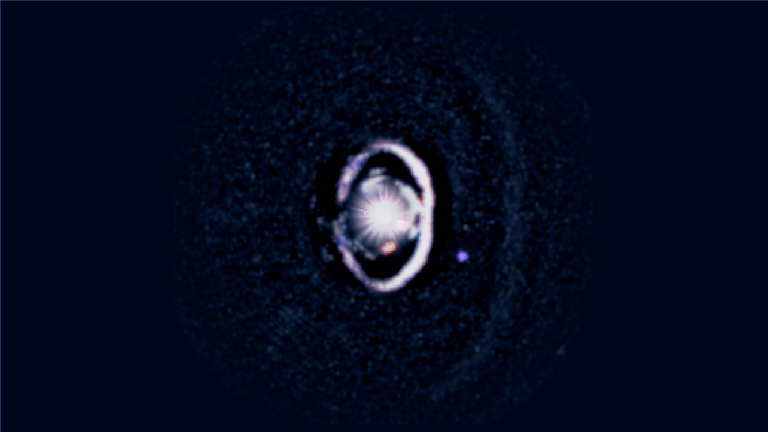
For the first time in history, astronomers have directly photographed a young planet located in a ring-shaped gap in the disk around a star. The object, named WISPIT 2b, is a massive gas giant—about five times larger than Jupiter—that is still accumulating matter and gradually forming into a full-fledged planet. The discovery was made by an international team led by Laird Close (University of Arizona) and Richelle van Capelleveen (Leiden Observatory). The results were published in the Astrophysical Journal Letters in August 2025.
Until now, scientists had only speculated that gaps in protoplanetary disks were caused by the presence of young planets. Now, thanks to observations of the WISPIT 2 system, located about 437 light-years from Earth, this hypothesis has been confirmed.
Images taken with telescopes in Chile (Magellan Telescope) and Arizona (Large Binocular Telescope) showed a clear bright structure of dust rings surrounding the star, and a purple dot in one of the gaps. This is the protoplanet WISPIT 2b, only 5 million years old, which is almost a thousand times younger than Earth.
The MagAO-X instrument, operating at the Las Campanas Observatory in Chile, played a key role. Thanks to specialized imaging technology in H-alpha light, which is produced when gas falls from the disk onto the planet’s surface, scientists recorded a signal indicating the process of matter accretion. Combined with infrared observations obtained with the Large Binocular Telescope, this allowed the presence of a new planet to be unequivocally confirmed.
This is the first direct confirmation that young planets actually “carve” ring-shaped gaps in protoplanetary disks by moving and dispersing matter. Studying this process may help us understand how the Solar System was formed – perhaps Jupiter and Saturn once shaped rings around the young Sun in a similar way. During their analysis, the scientists also noticed a second bright spot in another gap in the disk around the star WISPIT 2.